
Artwork Record
Images
Metadata
Artist |
Newton Haydn Stubbing (1921-1983) |
Date |
1961 |
Medium |
oil |
Dimensions |
18 ins. x 24 ins. |
Description |
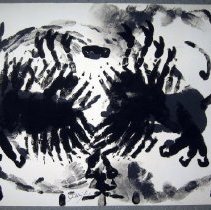
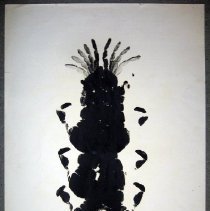
Newton Haydn Stubbing--known as Tony to his friends--was born into a conventional English family. After World War II, determined to break away from his conservative upbringing, and with no interest in the family business, he rode his bicycle to Spain, taking odd jobs so he could paint, draw, and make ceramics. After experiencing the cave paintings of Altamira, he felt a deep connection to their spiritual symbolism; they inspired him to paint directly with his hands on canvas, beginning in the mid-1950s. These early works, which Stubbing called "Ceremonials" and "Rituals," bear some kinship with the Abstract Expressionist movement but, like the cave paintings, evoke sensations of mystery and magic. According to Alfred H. Barr, Jr., Stubbing was the first contemporary artist to paint with his hands. Strictly speaking this may be true, though Pollock had earlier embellished "Number 1A, 1948," in the Museum of Modern Art's collection, and "Number 1, 1950: Lavender Mist," with numerous handprints. In Stubbing's works, however, the imagery is created entirely with handprints, often completely covering the surface of the canvas or paper. He used this technique exclusively for the next fifteen years, until ill health--possibly the result of absorbing paint chemicals through the skin of his palms--forced him to return to using brushes. In 1970 Stubbing and his companion, Yvonne Hagen, began dividing their time between London and Sagaponack, New York, where the light is luminous and the landscape pastoral. Many of his later paintings reflect that atmospheric environment, and similarly evocative landscapes in Scotland, Shelter Island and the Rocky Mountains. Gift of Sandra and Andrew Russell. |
Catalog Number |
2001.007.2 |
Object Name |
Painting |
Current Exhibition |
Crosscurrents: Selections from the Permanent Collection |